Submitting a Letter of Intent (LOI) for a PCORI grant? This step is more than a formality; it’s the first chance to demonstrate that your study is patient-centered, innovative, and impactful. One of the biggest challenges research teams face at this stage is showing meaningful patient engagement. Reviewers are actively looking at the LOI for evidence that patients’ perspectives shape the study.
In today’s research environment, patient-centeredness is no longer a philosophical aspiration; it is a requirement – and it’s one that can be measured! Nowhere is this more evident than in proposals to the Patient-Centered Outcomes Research Institute (PCORI), where reviewers expect early proof that a study is shaped with patients rather than simply about them. The challenge, however, is that demonstrating meaningful patient engagement at the Letter of Intent (LOI) stage can be difficult.
This is where patient-centric technology plays a critical role: including technology purpose-built to engage participants can demonstrate robust stakeholder engagement, even at the LOI stage.
What is a PCORI grant?
For researchers that have never applied for funding with PCORI, these grants provide funding via the Patient-Centered Outcomes Research Institute. These funding mechanisms support comparative clinical effectiveness research (CER) that helps patients, caregivers, and clinicians make better-informed healthcare decisions.
Unlike many NIH research grants that focus primarily on scientific discovery or mechanistic understanding, PCORI-funded studies must start with the questions and outcomes that matter most to patients. PCORI emphasizes real-world relevance, stakeholder involvement, and outcomes that directly influence daily health decisions. Every funded study must show how patients, caregivers, clinicians, and community stakeholders are actively engaged throughout the research lifecycle, from shaping the research question to interpreting and disseminating results.
What makes PCORI grants fundamentally different is that they are built on a patient-first framework, not a researcher-first one. PCORI reviewers expect to see meaningful engagement, transparent communication, and methods that reduce participant burden while increasing inclusivity and real-world applicability. Studies must compare interventions or approaches already used in practice, rather than testing speculative or early-stage concepts. As a result, a competitive PCORI LOI or proposal looks less like a traditional research plan and more like a collaborative partnership between investigators and the populations they serve. It should demonstrate that you listen to the patient voice, prioritize shared decision-making, and ensure that findings will translate into actual improvements in health outcomes and healthcare delivery.
Why Patient Engagement Matters in a PCORI LOI
PCORI’s entire funding model is built on a simple but transformative expectation: research must begin with the lived experiences, priorities, and decision-making needs of patients and caregivers. The focus on real-world relevance means investigators must show, even at the LOI stage, that they understand their patient population, have listened to their concerns, and are prepared to design a study that reflects those perspectives from day one.
Because of this emphasis, PCORI reviewers are looking for more than a compelling research question. They are looking for signs that the proposed study has been shaped with patients, not merely for them. They want to know that the outcomes being measured are meaningful in daily life, that the methods minimize participant burden, and that the study reflects clinical scenarios and choices that patients and clinicians confront in the real world.
At the LOI stage, you need to communicate:
- Who your stakeholders are and how they are involved.
- How patient input informs the study design and outcomes.
- Evidence that your team can collect patient-centered data reliably.
Where Patient-Centric Technology Strengthens Your LOI
Patient-centric technology enhances a PCORI LOI by demonstrating that the proposed study will meet participants where they are. Instead of requiring in-person visits or burdensome manual processes across multiple systems, digital platforms enable continuous, low-effort data collection from multiple sources: patient-reported outcomes, wearable devices, biospecimen tracking, surveys, and real-world data streams. This reduces the workload on participants while expanding the richness of the dataset researchers can access. Equally important, these technologies support sustained engagement through reminders, multilingual interfaces, flexible participation options, and ongoing communication that keeps participants informed and connected to the study’s purpose.
Vibrent’s platform has been validated across large, diverse national research programs, and including it in your LOI is a credible, evidence-based way to show that the study can adopt best practices from programs like the All of Us Research Program.
We can strengthen your LOI and final submission by demonstrating how we can work together to:
- Reduce Participant Burden While Collecting More Data:
Streamline participation by allowing patients to contribute information on their own schedule through mobile and web-based tools. This makes it easier to capture longitudinal patient-reported outcomes, biospecimens, eConsent, and real-world data from multiple sources without adding extra strain on participants.
- Enable Comprehensive, Multi-Source Data Collection:
Leverage Vibrent to integrate data from surveys, devices, and other digital health sources, ensuring that your study captures a rich, holistic view of patient experiences. This makes it possible to gather more actionable insights across larger, more diverse populations.
- Support Ongoing, Meaningful Engagement:
Demonstrate a clear plan for keeping participants informed, motivated, and actively involved throughout the study. Vibrent’s tools provide reminders, multilingual support, and flexible engagement options, showing that participant involvement is both measurable and sustained.
By referencing these capabilities in your LOI, you show PCORI reviewers that patient-centered design is woven into every aspect of your study, from participation logistics to data collection to ongoing engagement-not simply an afterthought.
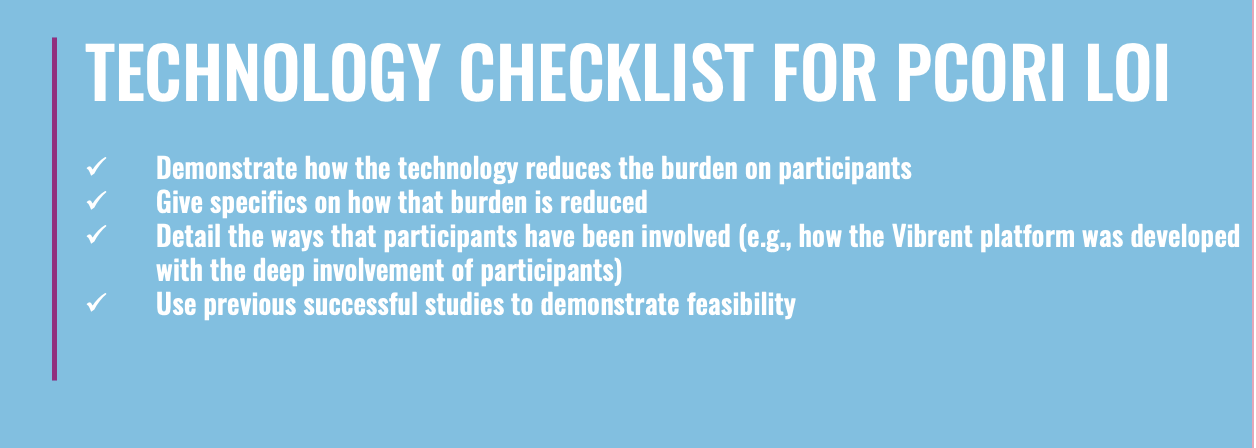
How to include patient-centric technology in your LOI
Describing the patient-centric technology is one of the parts of your LOI that can demonstrate how you will measure success, and that can demonstrate validated methods.
Today there are numerous publications that validate the use of Vibrent’s technologies in diverse populations, and those precedents can strengthen your LOI by providing reviewers with concrete evidence that your study is feasible, participant-focused, and informed by tools already validated in large, diverse research programs.
When describing Vibrent in your LOI:
- Show patient-centeredness: Reference Vibrent’s validation with large-scale, diverse research programs. NIH All of Us is one of them – and the methods used to involve the patient voice in design was promoted very publicly. Building on technology that was purpose-built for participant use will reassure reviewers that your approach is grounded in the tenets of the PCORI mission.
- Highlight participant-focused capabilities: Showcase features that reduce participant burden and support rich engagement, including eConsent, ePRO/eCOA, multilingual interfaces, longitudinal tracking, and integration of multi-source real-world data.
- Demonstrate feasibility: Explain how Vibrent has been successfully implemented across multiple studies already. Reusing this technology enables seamless, secure, and reliable collection of patient-centered data, making it practical to gather meaningful insights without overtaxing participants.
Can Vibrent help me with my LOI?
Incorporating patient-centric technology into your PCORI LOI sends a powerful signal to reviewers: your study is designed around participants, grounded in real-world evidence, and equipped to collect meaningful data with minimal burden. By demonstrating the ability to engage patients effectively, capture longitudinal and multi-source outcomes, and leverage validated, scalable platforms like Vibrent, your LOI moves from concept to credibility.
If you’re preparing a PCORI submission, we can provide you with content and use cases that can strengthen your LOI and project materials.
When you are ready to explore how Vibrent can strengthen your patient engagement strategy, reduce participant burden, and showcase feasibility, request a meeting with our team to discuss your grant and explore tailored solutions.


